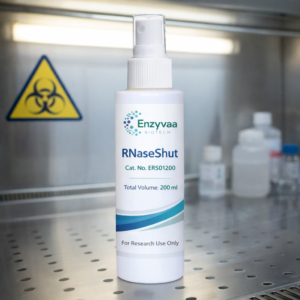
RNaseShut
RnaseShut Decontamination Solution is a ready-to-use surface decontaminant designed to rapidly eliminate RNases upon contact. To use, simply spray the solution onto the surface requiring decontamination and rinse thoroughly with RNase-free water.
Key Features of RnaseShut RNase Decontamination Solution
- Effectively removes RNase contamination from both glass and plastic surfaces
- Demonstrates superior performance against heavy RNase contamination where comparable products are ineffective
- Proven to inactivate high levels of dried RNase A
- Ideal for maintaining RNase-free work areas, including benchtops, pipettors, and laboratory equipment
Specifications
| Application | RNAase Clean Up From Workbench |
| Quantity | 100 ml, 200 ml |
| Compatability | RNA Work |
| Form | Liquid |
| Shelf Life | RT (12 Month) |
Using RnaseShut Solution
RNA-based workflows demand strict control of RNase contamination, as even trace amounts can compromise experimental outcomes. RNase activity may result in reduced yields during in vitro transcription, RNA degradation during purification, and inconsistent results in RNase protection assays (RPAs) and Northern blotting.
RnaseShut contains three active components that target RNases and has been shown to efficiently remove RNase contamination from glassware, plasticware, laboratory surfaces, and pipettors. It is also effective in decontaminating microfuge tubes without interfering with subsequent enzymatic reactions. The product is supplied as a 250 mL bottle.
RNase Contamination in Microfuge Tubes
Although researchers are typically vigilant about RNase contamination on frequently handled labware, commercially manufactured consumables such as microfuge tubes are often assumed to be RNase-free. In a study examining six standard 1.5 mL microfuge tubes, three tubes were pre-rinsed with RnaseShut followed by water, while three were left untreated. All untreated tubes showed detectable RNase contamination, whereas none of the RnaseShut-treated tubes exhibited RNase activity. Furthermore, testing of commercially labeled “RNase-free” microfuge tubes revealed that approximately 10% contained measurable RNase contamination (data not shown). Such contamination may contribute to the inconsistent results occasionally observed in RNA-based experiments.

Documents
Manuals and Protocols
User guide : RNaseShut
Material Safety Datasheets (MSDS)
#MSRS01250