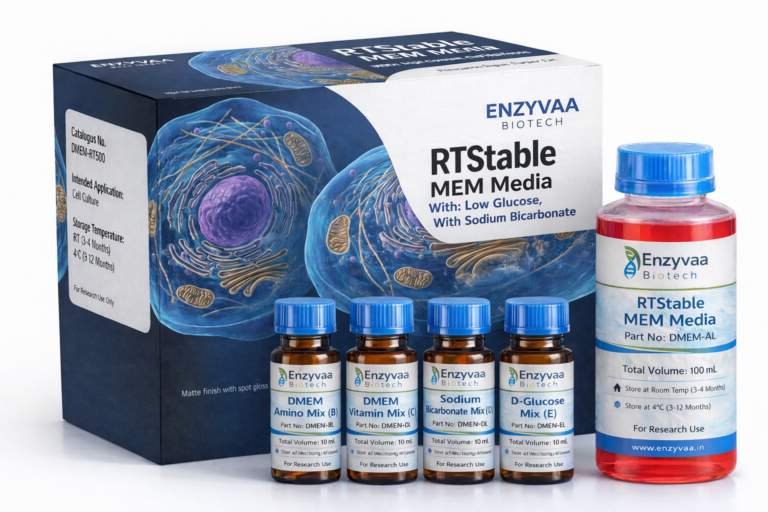
RTStable MEM Media
with Low Glucose, Sodium Bicarbonate
Minimum Essential Medium (MEM) is one of the most widely used cell culture media and supports the growth of a broad range of suspension and adherent mammalian cells. Commonly cultured cells in MEM include HeLa, BHK-21, 293, HEP-2, HT-1080, MCF-7, fibroblasts, and primary rat astrocytes.
RTStable MEM is specifically engineered for storage at room temperature while maintaining robust cell proliferation and achieving maximum cell densities comparable to those obtained with conventional MEM when supplemented with ≥10% fetal bovine serum (FBS).
Key modifications of RTStable MEM include
- Optimization for room-temperature stability
- Low glucose, RTStable glutamine and phenol red
- Inclusion of sodium bicarbonate
- Does not contain HEPES
Specifications
| Application | Animal Cell Culture |
| Compatability | HeLa, BHK-21, 293, HEP-2, HT-1080, MCF-7, and fibroblasts |
| Product Type | MEM (Minimum Essential Medium) |
| Form | Liquid |
| Classification | Animal Origin Free |
| Sterility | Sterile |
| Additive | RTStable Glutamine, Low Glucose,Sodium Bicarbonate, Phenol Red |
| Shelf Life | RT (3-4 Months), 4 oC (9-12 Months) |
Using RTStable MEM
Originally developed by Harry Eagle, MEM was derived from his earlier Basal Medium Eagle (BME) formulation. Over time, several modified versions of MEM have been introduced, including Glasgow’s MEM, MEM α, DMEM, and Temin’s Modification. MEM is available with either Earle’s salts for use in CO₂ incubators or Hanks’ salts for CO₂-free systems; this formulation contains Earle’s salts.
The inclusion of RTStable Glutamine reduces toxic ammonia accumulation, thereby enhancing cell viability and growth while offering a convenient, ready-to-use format. RTStable MEM requires supplementation with ≥10% fetal bovine serum (FBS) for optimal performance.

Documents
Manuals and Protocols
User guide : RTStable MEM – Low Glucose
Material Safety Datasheets (MSDS)
#MSM01500